Our own project · In development
Poder y Nación
A political and economic simulator of Spain, played in monthly turns and built from scratch. Not a client project either — it's ours, and these screenshots are the game actually running.
What Poder y Nación is
Poder y Nación puts the player in charge of Spain as Prime Minister — or as the opposition leader trying to become one — in a political and economic simulator played in monthly turns. It isn't a strategy game wearing political clothes: it models how a state actually works from the inside, its ministries, its parliament, its autonomous regions, its relationship with Europe, and the real consequences, with real delay, of every decision the government makes.
One country, simulated in depth
Simulators in this genre spread their complexity across dozens of countries and, inevitably, simplify each one into a generic model. Our bet is the opposite: take a single country and simulate it at a level of detail we haven't found in any other game in the genre. All 19 autonomous regions have been there since day one of the project — there was never a cut-down version "to get started". Each has its own parliament with the real seat counts (Catalonia 135, Andalusia 109…), a regional government led by a named political baron with his or her own ambition and affinity — or hostility — towards Madrid, and its own real investiture cycle: first round by absolute majority, second by simple majority, or a minority government if no deal is reached.
The electoral system reproduces the D'Hondt method province by province, and the distribution of the 350 seats is recalculated before every election according to how the population has shifted. That makes real features of the Spanish system emerge on their own — such as a small, geographically concentrated party winning more seats with fewer votes than a large, thinly spread one. The disproportionality the model produces, measured with the Gallagher index, falls within the real range of Spanish elections.
Screenshots
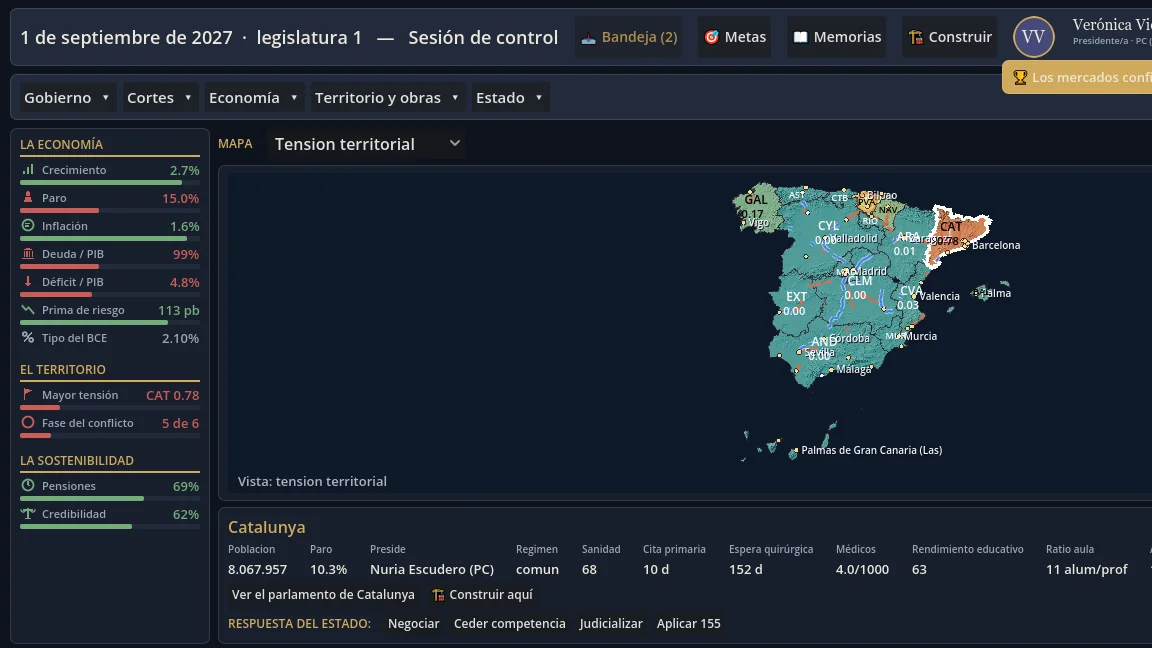
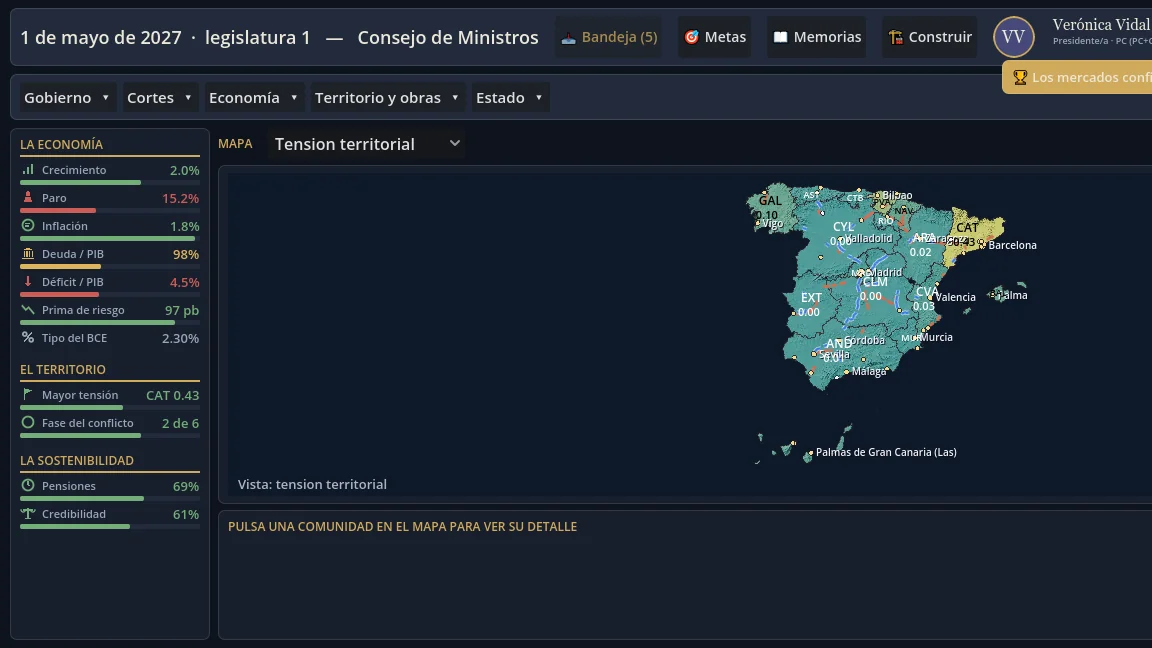
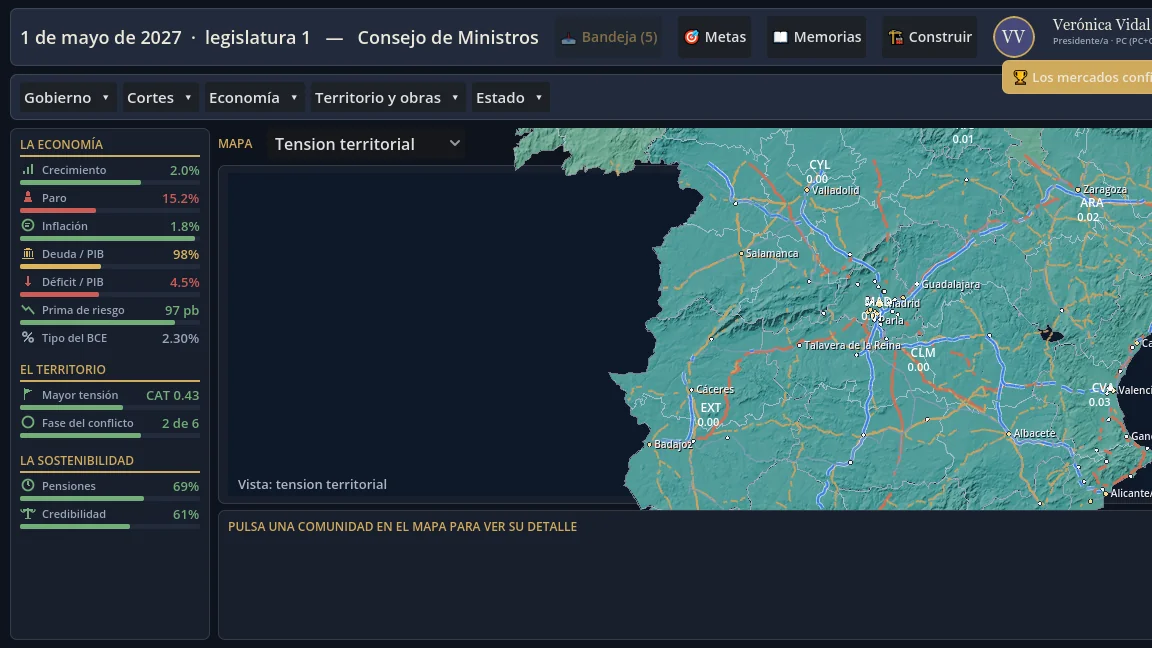
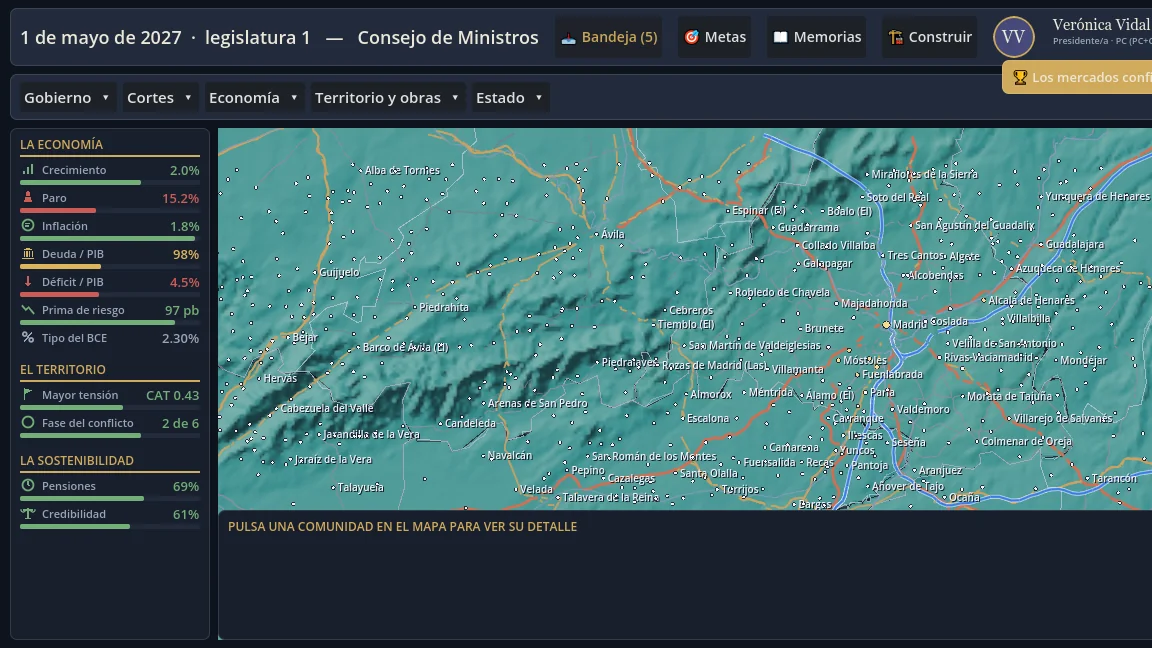
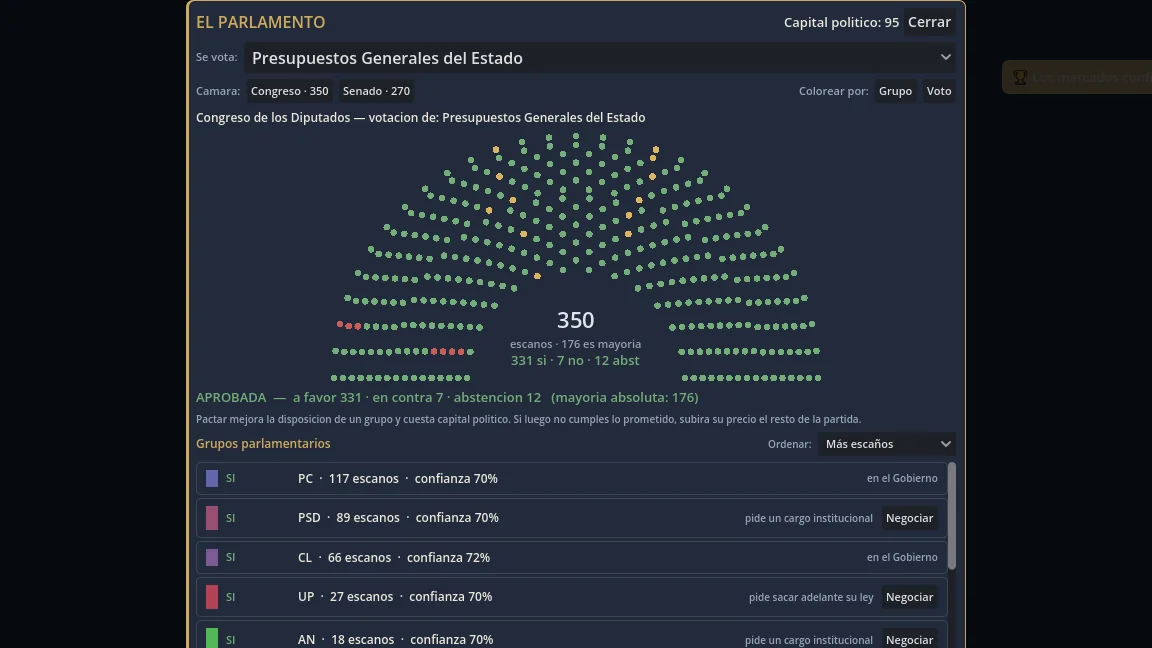
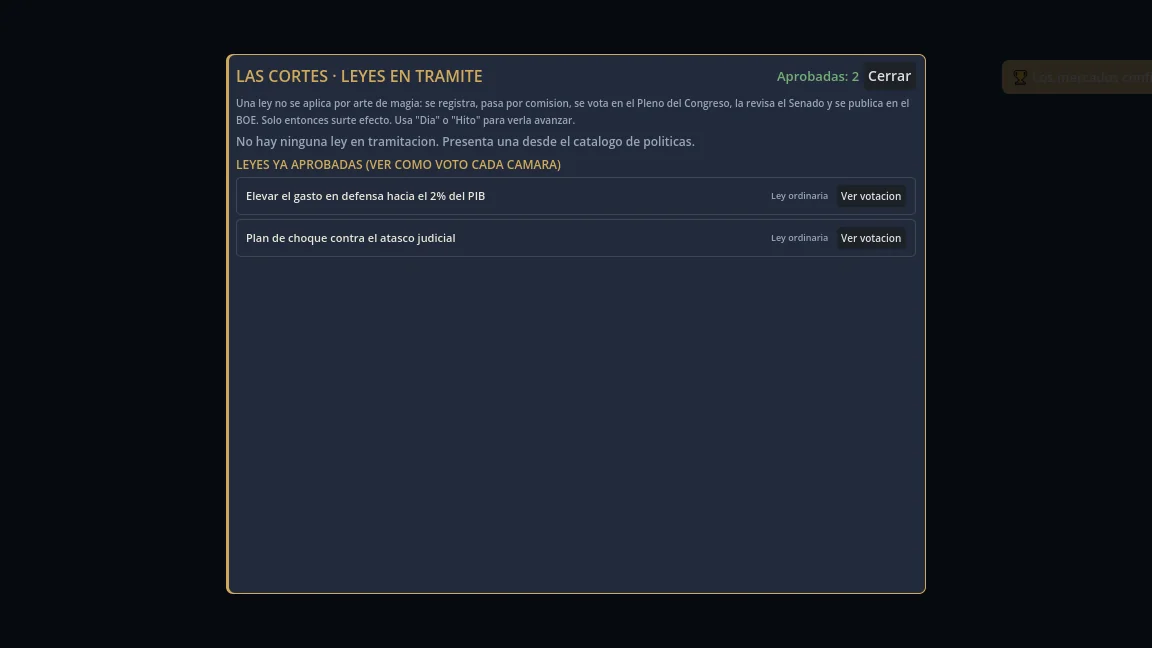
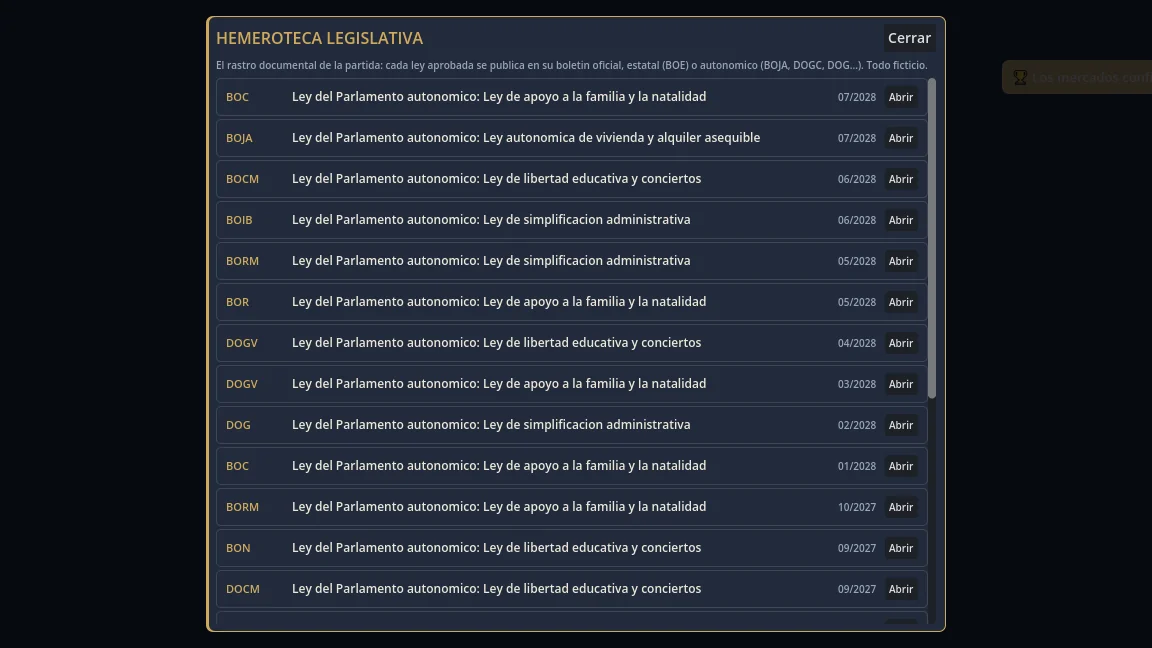
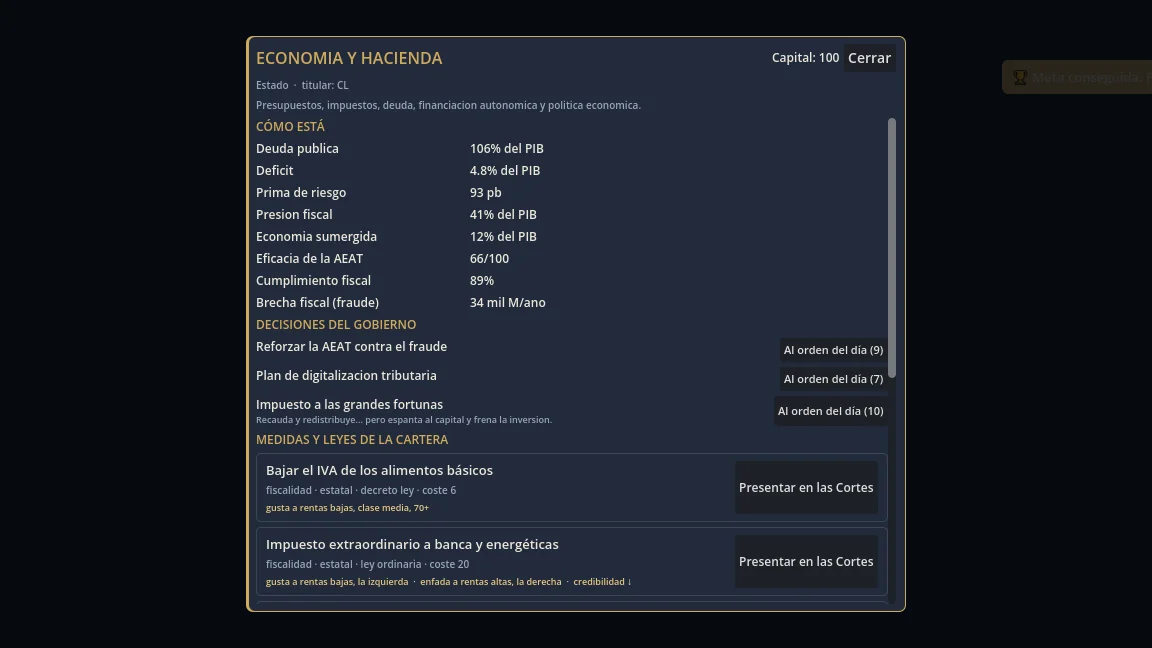
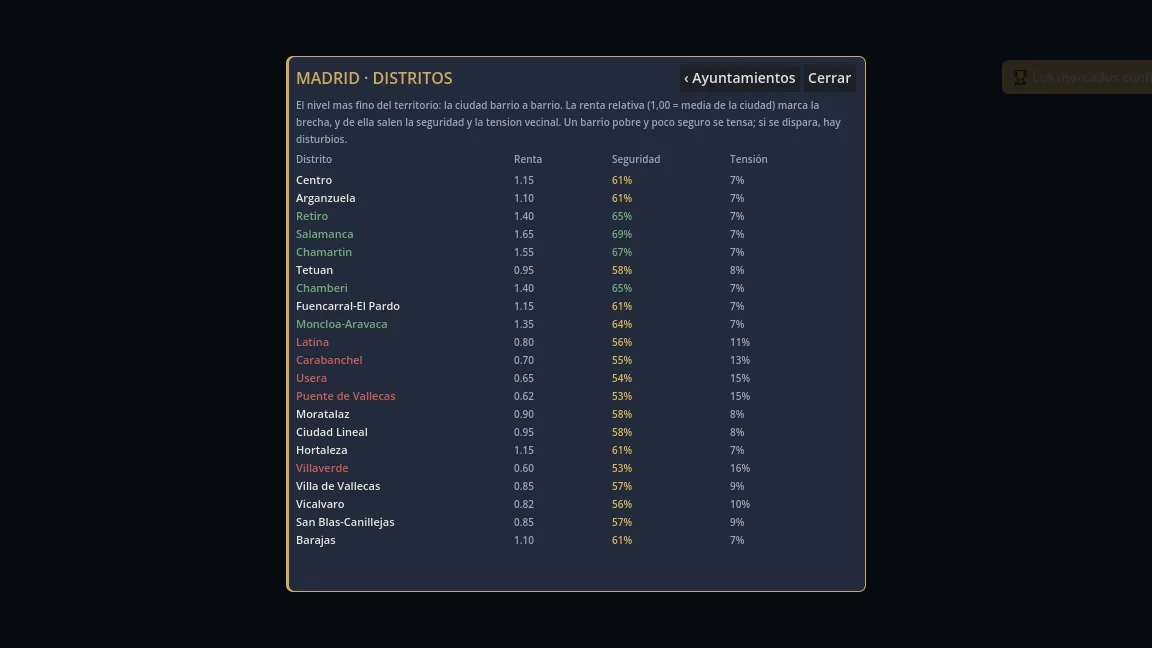
Screenshots of the game in development (v0.5.0). The parties and characters shown are fictional. The final art isn't locked: what you see here may change.
Actually governing, not just watching outcomes
This is the deepest difference. The game doesn't merely calculate how the country evolves: it models the real process of governing. The legislative engine is real — bills travel through their actual stages (registration, committee, floor vote, Senate, official publication) and only take effect if they gather the majority their legal rank demands. The Senate has its own, heavily provincial composition, with 270 seats and the leading party over-represented, plus its real Article 90 veto, which the lower house can only override with the timings and majorities the Constitution sets out. Every law passed generates its own fictional official gazette — the national one or the relevant regional one — browsable in an in-game archive as a permanent documentary record of the playthrough.
The Council of Ministers genuinely works: executive decisions aren't applied instantly, they go onto the agenda and only become decrees once the Council approves them — at the ordinary Tuesday meeting, or at an extraordinary one — and only if the government can afford them with its political capital. A decree decided on a Thursday doesn't reach the gazette until the following Tuesday. Negotiation has memory: cutting a deal with a parliamentary group improves its disposition, but breaking your word raises its price for the rest of the game. And governing in a minority really means governing in a minority — a coalition partner can threaten to walk out mid-term, and both giving in and standing firm cost you dearly, up to the point of bringing the government down.
None of this pays off instantly, which is exactly the point: no significant structural reform does. A crackdown on tax fraud doesn't raise revenue that same week; it takes months, just like the real tax agency. Letting the deficit run out of control doesn't bite immediately — until one day the European Union opens an excessive deficit procedure and the risk premium spikes. The consequence arrives, but it arrives late — which forces you to govern with the medium term in mind, not just to put out whatever fire is burning today.
The map is the board
The entire game takes place on a real map of Spain: the official outlines of the 19 regions, the road and rail network with all its actual curves — not simplified straight lines — the genuine relief of the mountains clipped to the country's silhouette, and 13 switchable data layers (territorial tension, unemployment, GDP per capita, healthcare, education, medical waiting times, housing prices, who governs where…) that turn it into a constant thermometer of the whole country. The map streams in by sections as you zoom, like any modern digital map, and drills down to the finest level: the 47 largest cities have their own council seats allocated by D'Hondt under the electoral law, and the biggest ones break down into their districts — Madrid into 21, Barcelona into 10 — each with its real relative income, from which the neighbourhood's safety and social tension are derived.
What's already real
Neutral by design, not by disclaimer
The parties in the game are fictional: the system is realistic, but no name identifies a real political force. And no ideology is rewarded or punished by design — the game is built mathematically so that the centre of public opinion always anchors to the centre of gravity of whichever party system is in play, never fixed in advance by whoever designed it. Every new block of content is verified against a twenty-year balance run that checks no ideological split drifts. The game shows you the consequences of each decision; it doesn't tell you which one is right.
How it's built
The game is built entirely in Godot, with a simulation core that runs headless — which is what makes it possible to test and calibrate it with twenty-year playthroughs simulated in seconds — and a full playable interface built in code, with no visual editor. All game content (policies, events, calibration parameters) lives in external data, never in the code, so extending it doesn't mean touching the engine.
The cartography uses open data, with the attribution its licences require: the road and rail network and the street layer come from OpenStreetMap and its contributors (ODbL licence); the relief, from Terrarium elevation data (AWS Open Data); and the official administrative outlines from Spain's National Geographic Institute via geoBoundaries (CC BY 4.0).